

Good Mo(u)rning

Last Tuesday was the five-month anniversary of my mom’s death. I am changed. And my grief is ever-changing.
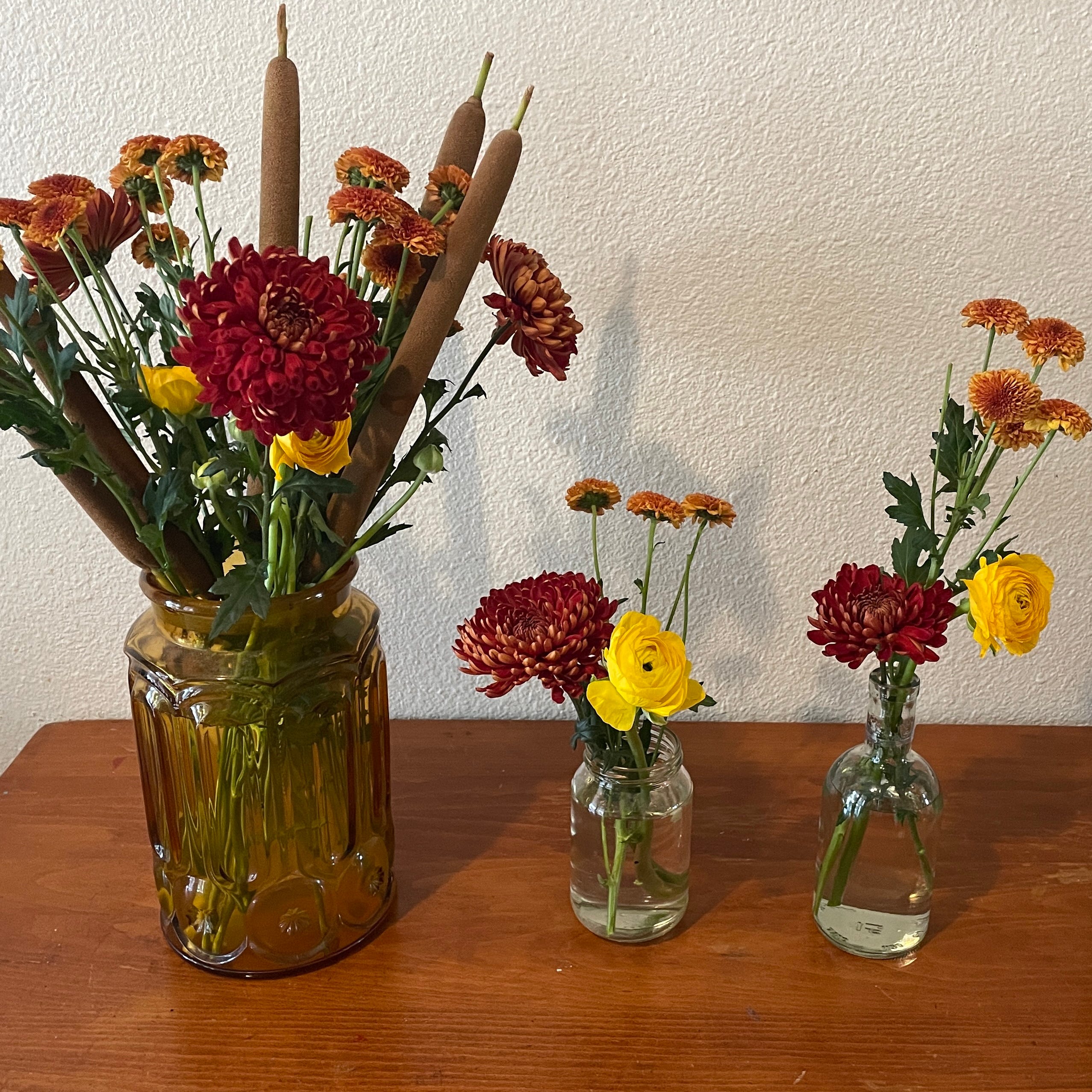
That morning, my dad and I went to visit my mother’s grave—a ritual we adopted during the first 49 days after her death and at anniversaries. We brought flowers. We spoke to her. We watched as dragonflies flew low over the green grass and as a bee wandered around the petals of one of the hot pink rose I’d placed in the glass vase that was on my parents’ kitchen countertop and is now in the ground. My dad had used a trowel to carve a round shape in the ground where it could nest. We have made this impromptu altar until we have a headstone.
We told her we missed her. We told her about my recent show on Frenchman Street, how she would’ve loved it. We told her it was hard here without her.
On the way home, I shared with my dad a new song called “What Bird Did You See?” off songwriter Dar William’s most recent album. A panoply of birds are ushered through the song in description and motion: a seagull, a gold finch, a red-tailed hawk, a cardinal. The refrain is “What Bird Did You See?” The last line of the song says, “It’s okay to know it’s me.”
I had the opportunity to hear Dar sing the song on a songwriting retreat, about eight months before my mom died. She talked about the liminal space after someone dies and the way it is a common experience for people to experience their loved ones through the natural world, through these visitations. And how even skeptics often have their minds changed. These moments help us see and feel seen, they reverberate with the mysteries of life and death. Songs like these help us feel seen, too.
My dad drove us home as we listened. It was a good morning. It was good mourning.
Later that night, I turned on Somebody Somewhere because I was ecstatic that Jeff Hiller won an Emmy for his excellent portrayal of Joel. The show—which phenomenal creator and star Bridget Everett has called “a coming of middle-age story”—is a comfort show for me, a companion through life’s ups and, particularly, life’s downs. And it just so happens that where I had left off, in my latest rewatch, was the scene when Sam, the protagonist played by Everett, and her younger sister Trisha are sitting in their dead sister’s living room talking about grief.
The scene happens when Tricia comes to where Sam lives in their sister’s former house, because she realizes they have both forgotten their sister Holly’s birthday. In the moment I reentered the episode, Tricia is telling Sam that she herself did grief wrong while Sam did it right. Sam says that she doesn’t think that’s true. “You did it one way, I did it another way—we both end up in the same place,” she offers. Trisha says, “I think you did it better.” Sam replies, “I don’t think there’s any better.”
As someone who has struggled with perfectionism my whole life, I notice the way these patterns show up even in my grief. Especially in moments of inner turmoil, I attempt to measure it. How much crying is enough or too much? What is the normal amount of time to feel bereft? How many people are enough to help me hold this pain? How much holding on is appropriate? How much letting go? Even if I feel these questions are false and know that, at their core, they are an attempt to find ground where there is no ground, they arise in my mind’s eye. As if grief is an algebra problem. As if there is a clear x or y that simply needs to be plugged in in order to solve the equation of absence.
My mom was a strong presence in life and she is a strong presence in death. In the first four months of her being gone, her absence felt like an avalanche. The missing was so intense it was sometimes hard to breathe, hard to get out of bed in the morning. Sometimes it still feels that way. And sometimes I am able to feel her so strongly it is as if she’s right here next to me. It’s not the same and that will always be a grief. But talking to her, writing to her, feeling her in objects she held and in the natural world is a great comfort.
A few days after the anniversary, I had friends over for supper. I cooked corn maquechoux, a Cajun dish my mom taught me how to make.
“Help me out with this, Mom,” I said aloud as I drove to the grocery store and again when I was cutting the corn off the cob in layers.
When I was at a retreat in August, a musician friend K told me, while thrumming a beat with her fingers on the car wheel, that the conversation with my mom isn’t over. “The relationship with my mother is ever-evolving,” she says. “The relationship didn’t end when she died.” She sung a little song that her mother used to sing. This framing not only made sense to me but opened up a door to something that felt real and true.
I feel close to my mom when I’m cooking because the kitchen was her favorite place. She loved making meals to share with loved ones. Her love language was a delicious meal lovingly prepared. So as I repeat the motions she executed so many times in her life, I feel her forearms inside my forearms, tensing as we cut and scrape the corn; her hands inside my hands stirring in onions in the pan. I feel us wiping the sweat from our brow.
Here is my mom, alongside me as I prepare one of her favorite dishes. Here is my mom’s voice in the recipe I hold I my hand. Here is my mom, still teaching me how to cook.
Nuggets of beauty, hope, and inspiration
The Jailhouse Lawyer by Calvin Duncan & Sophie Cull : I just finished this fantastic book written by Calvin Duncan, who spent twenty-eight years at Angola State Penitentiary serving a life sentence for a crime he didn’t commit before being released and exonerated (Here’s an NPR interview with him). His release and exoneration came from his own work on his case as well as the diligent work of his legal team at Innocence Project New Orleans, now Innocence and Justice Louisiana. The book is excellent because, through personal narrative of Duncan’s unjust trial and sentence and his decades working as an inmate counsel, Duncan and Cull reveal the systemic flaws in our criminal justice system and the enormous barriers people face to getting justice. On top of it, they write the book in a way that makes legal decisions accessible to those of us without a law background. I think every American should read this book. Get it from your favorite independent bookseller or in physical, digital, or audiobook from your library (so important to support libraries always and definitely now!)
I had the privilege of seeing the phenomenal Arundhati Roy, a longtime literary and social justice heroine of mine, read and speak from her new book Mother Mary Comes to Me (more on this soon) last week. I haven’t read her new book yet, but I’m looking forward to it. I also recommend her stunning essay “The End of Imagination,” originally published in The Guardian in 1998, that I read a long time ago and which she quoted from at her reading.
Last month, I discovered the gorgeous textile art of Rachel Hayes. I love these bold and beautiful tapestries she creates and love more the attention that is given to how they interact with landscapes. Click here for some beauty.
Hummingbird Highway, the album hosting the song I mentioned above, is delicious start to finish. Here’s one way to listen.